Engineered to comply with stringent CE directives, international electromagnetic compatibility (EMC) standards, and ruggedized operational envelopes.
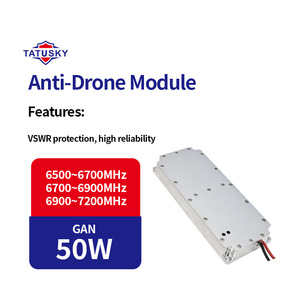

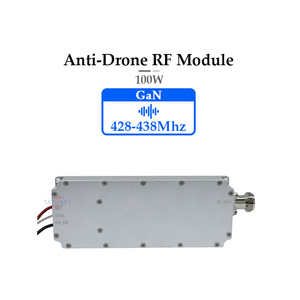
In the contemporary landscape of high-frequency defense applications, tactical unmanned aerial vehicle (UAV) countermeasures, and high-voltage power electronics, procurement directors face a complex matrix of regulatory, thermal, and electromagnetic challenges. The shift toward higher operating voltages and wide-bandgap semiconductors—specifically Gallium Nitride (GaN) on Silicon Carbide (SiC)—has fundamentally altered the design requirements for Solid-State Power Amplifiers (SSPAs) and high-voltage conversion modules. Achieving compliance with European Conformity (CE) directives while ensuring rugged operational resilience under MIL-STD environmental and electromagnetic envelopes requires an integrated engineering methodology from component selection to final chassis potting.
Traditional Silicon-based LDMOS transistors hit a physics-bound limit in power density, switching frequency, and thermal dissipation when operated above 3 GHz. Modern CE Certified High Voltage RF Power Modules utilize GaN High Electron Mobility Transistors (HEMT) fabricated on high thermal conductivity substrate materials.
This wide-bandgap chemistry enables elevated drain breakdown voltages (typically 28V to 50V DC operational rails), reduced junction-to-case thermal resistance ($R_{thjc}$), and ultra-linear amplification across multi-octave bandwidths (e.g., 700 MHz to 6000 MHz). Consequently, system integrators achieve up to a 60% reduction in total payload mass while doubling effective radiated power (ERP).
Exporting defense-grade power systems and high-voltage modules into international markets mandates strict alignment with European Directives including 2014/30/EU (EMC Directive) and 2014/35/EU (Low Voltage Directive).
Meeting these harmonized standards necessitates multi-stage EMI suppression networks, active power factor correction (PFC) stages achieving >0.98 power factor, and stringent enclosure shielding against conducted and radiated immunity thresholds. By synthesizing CE engineering protocols with rigorous shock, vibration, and thermal cycling methodologies derived from MIL-STD-810 and MIL-STD-461, top-tier manufacturing exporters ensure zero operational degradation in harsh field deployments.
| Module Category | Frequency / Rail Spectrum | RF Output Power / Current | Efficiency Profile ($\eta$) | CE & International Standards | Primary Deployment Domain |
|---|---|---|---|---|---|
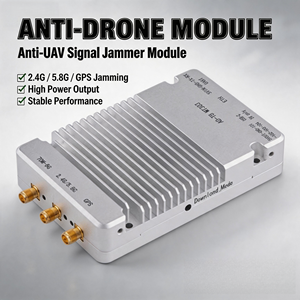
| Wideband GaN Amplifier | 700 MHz – 6000 MHz | 80 Watts CW | ≥ 42% Power Added Efficiency | EN 61000-6-2, EN 61000-6-4, CE | Anti-FPV Countermeasures, Electronic Warfare |
| C-Band GaN Module | 6.5 GHz – 7.2 GHz | 50 Watts Saturating | ≥ 38% PAE at P3dB | EN 55032 Class A, CE EMC Directive | Tactical UAV Defense, Fixed Site Jammers |
| High-Power Sub-GHz Module | 428 MHz – 438 MHz | 100 Watts Pulsed / CW | ≥ 55% Drain Efficiency | CE LVD 2014/35/EU, RoHS 3 | Long-Range Remote Command Suppression |
| Targeted L-Band Module | 1160 MHz – 1260 MHz | 10W / 30W / 50W / 100W | ≥ 48% Drain Efficiency | IEC 60950-1 / EN 62368-1, CE | GNSS Jamming & FPV Link Neutralization |
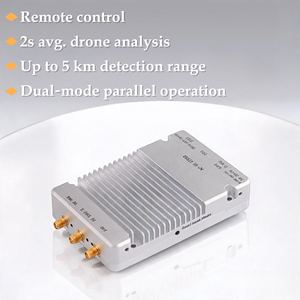
| Passive Detection Module | Multi-Band 2.4G/5.8G/O4 | Passive (Low Power Bus) | < 5W Operational Power | CE RED 2014/53/EU, EN 301 489 | Early-Warning UAV RF Spectrum Analysis |
An analysis of technological convergence, supply chain transformation, and next-generation defense procurement mandates over the next half-decade.
Global defense agencies are actively shifting away from legacy clean-sheet custom power development toward Modified Commercial-Off-The-Shelf (MOTS) hardware. By utilizing pre-certified CE and MIL-tested power sub-assemblies, prime contractors reduce Non-Recurring Engineering (NRE) costs by up to 70% while accelerating qualification schedules by 6 to 12 months.
Unmanned threats are rapidly evolving to utilize non-standard control frequencies and frequency-hopping algorithms (e.g., DJI O4 protocols and custom sub-GHz telemetry). Future procurement mandates require RF power modules to support dynamic digital pre-distortion (DPD) interfaces and ultra-wideband coverage (700MHz to 6GHz+) in unified, multi-mode chassis.
As power densities exceed $100\text{ W/in}^3$, conventional forced-air cooling reaches operational limitations in dusty, humid, or maritime environments. Exporters are heavily investing in IP65/IP67 sealed liquid-cooled or conduction-cooled enclosures utilizing advanced phase-change potting materials to preserve long-term mean time between failures (MTBF).
Combining over 100 years of power design heritage with state-of-the-art automated manufacturing and international quality certifications.
Our manufacturing complex operates under a certified ISO 9001 Quality Management System accredited through PJR and ANAB. Every high-voltage converter and RF defense module leaves the factory backed by rigorous CE certification documentation, test reports, and compliance statements for seamless global customs clearance.
With over 100 combined years of power design experience across aerospace, naval, and ground defense platforms, our engineering team excels at tailing standard platforms to match specific output rails, form factors, thermal envelopes, and custom MIL-spec connector pinouts without triggering clean-sheet NRE costs.
Every production batch undergoes automated burn-in testing, elevated thermal stress screening, and pre-compliance EMI/EMC evaluation against MIL-STD-461 and CE standards. This ensures uncompromised field performance under severe thermal transients and electromagnetic interference.
Fielded programs often operate over multi-decade lifecycles. We actively monitor component end-of-life (EOL) trajectories and offer guaranteed form-fit-function replacement hardware, preventing program downtime and costly system re-certifications.
Detailed answers for global procurement directors, defense integrators, and engineering buyers.
Whether you require customized GaN solid-state power modules, CE-compliant high-voltage converters, or tactical anti-drone system integration, our engineering staff is ready to evaluate your technical parameters.