Technology Outlook & Strategy Future Procurement Trends in Ruggedized Rack Mount UPS (2025–2035)
The global market for military and industrial ruggedized power backup is undergoing a massive architectural shift driven by AI processing at the edge, autonomous ground vehicle integration, electrification of naval platforms, and stringent cybersecurity demands.
1. Transition to Wide Bandgap (WBG) Semiconductors: GaN and SiC
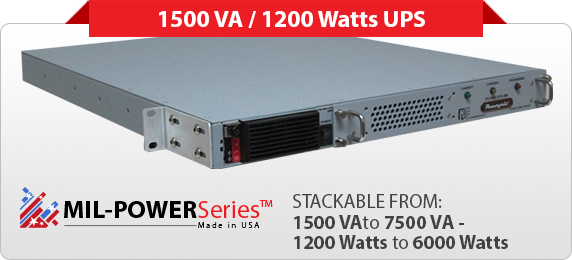
Legacy UPS topologies utilized Silicon (Si) IGBTs operating at low switching frequencies (10 kHz–20 kHz), which dictated large, heavy magnetics and bulk capacitors. Next-generation AJPS Ruggedized Rack Mount UPS designs incorporate Silicon Carbide (SiC) and Gallium Nitride (GaN) power switches. Operating at frequencies exceeding 100 kHz with near-zero switching losses, WBG semiconductors reduce internal magnetics volume by over 40%, yielding unprecedented power density in a 1U or 2U rack envelope.
2. Lithium Iron Phosphate ($LiFePO_4$) replacing Lead-Acid
While Sealed Lead-Acid (VRLA) batteries served the industry for decades, $LiFePO_4$ (LFP) chemistry has emerged as the clear standard for modern defense and industrial procurement. LFP offers a 300% improvement in energy density, 5x cycle life (>3,500 charge cycles vs. 500 for VRLA), rapid recharge capabilities, and unmatched thermal stability up to +60°C. Internal smart Battery Management Systems (BMS) with cell balancing and auto-heating mats enable full power discharge at -40°C.
3. Micro-Grid Integration & Bidirectional DC-Bus Coupling
Modern forward operating bases, mobile command stations, and industrial micro-grids require power backup platforms that seamlessly tie into hybrid generation assets (solar arrays, tactical diesel generators, vehicle 28V alternators). Future UPS architectures function as multi-port energy routers capable of bidirectional power flow between AC grid inputs, high-voltage DC buses, and auxiliary energy storage assets.