Explore our specialized tactical hardware, GaN high-power RF modules, and passive UAV defense architectures designed for extreme environments.

Ergonomic, lightweight tactical body armor engineered for maximum mobility, field durability, and anti-puncture protection.
Get Catalog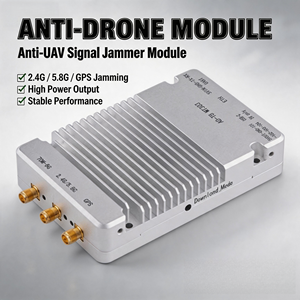
Ultra-fast 2-second signal analysis with passive RF remote monitoring over multi-frequency bands for power-efficient UAV defense.
Get Catalog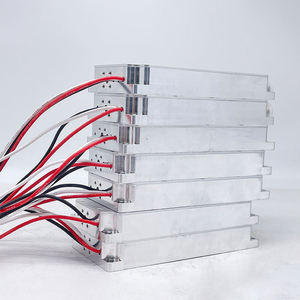
Solid-state Gallium Nitride power amplifier covering ultra-wideband frequencies for counter-FPV drone suppression systems.
Get Catalog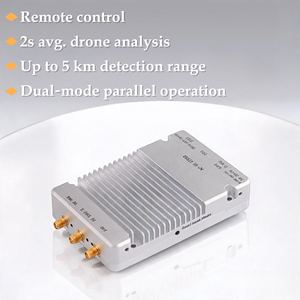
SWaP-optimized 60g miniature detection unit tailored for soldier-worn systems and lightweight drone defense integration.
Get Catalog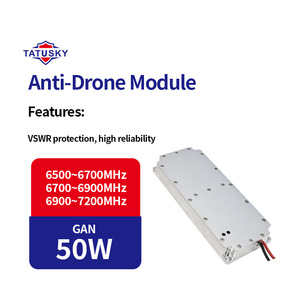
High-frequency C-band GaN power amplifier delivering high power density and thermal efficiency for airborne electronic countermeasure suites.
Get Catalog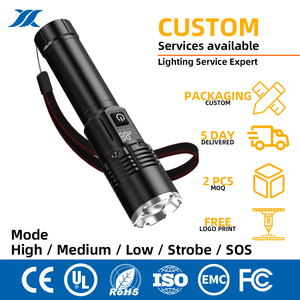
Ruggedized aluminum casing featuring real-time digital power status, high lumen zoomable beam, and tactical emergency defense capabilities.
Get Catalog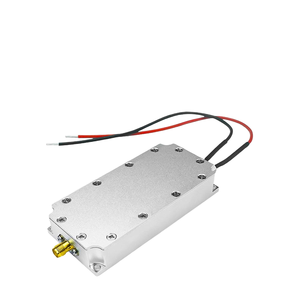
Customizable L-band power amplifier with variable wattage output designed for specialized counter-unmanned aerial vehicle platforms.
Get Catalog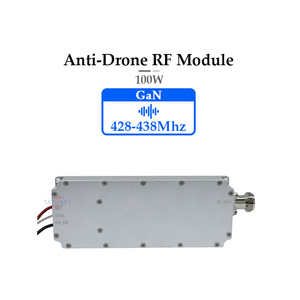
UHF band 100W power module utilizing GaN semiconductor technology to ensure optimal heat dissipation and extreme range signal disruption.
Get CatalogOur manufacturing plant and engineering teams deliver unmatched technical reliability for international defense primes and aerospace OEMs.
In modern aerospace, tactical defense, and counter-unmanned aerial systems (C-UAS), electrical power management has evolved from a passive utility into a core strategic asset. Modern airborne platforms demand power converters, RF amplifiers, and distribution units that adhere strictly to SWaP-C guidelines (Size, Weight, Power, and Cost) while functioning continuously under severe environmental stress. As an established OEM/ODM avionics power manufacturer and global exporter, our facility bridges the critical gap between high-density semiconductor innovation and field-tested military standards.
Key Engineering Insight: Transitioning from traditional Silicon MOSFETs to Gallium Nitride (GaN) on Silicon Carbide (SiC) substrates has increased RF power amplifier efficiency by over 35%, enabling 100W+ output power profiles within handheld, battery-operated counter-drone modules weighing under 500 grams.
Airborne electrical architectures are undergoing a fundamental transformation driven by increased electronic payload density. Legacy 28V DC and 115V AC 400Hz systems are rapidly integrating with 270V DC high-voltage distribution networks to reduce copper cable weight and minimize transmission losses across complex avionics bays. Navigating these requirements demands a thorough engineering approach:
The proliferation of unmanned aerial vehicles (UAVs) and FPV (First-Person View) loitering munitions has reshaped electronic warfare requirements. Power amplifiers utilized in counter-drone systems must maintain linear output power across ultra-wide frequency spectrums (from 433MHz up to 7.2GHz) while enduring continuous mismatch conditions caused by varying antenna VSWR.
By leveraging GaN-on-SiC technology, our OEM power modules achieve exceptional power-added efficiency (PAE), lowering internal heat generation and allowing for compact, passively-cooled tactical enclosures. Modules such as our 80W 700-6000MHz broadband RF units provide uniform jamming capability across multi-band remote control links, GNSS bands, and video downlink frequencies.
From COTS modification to ground-up clean-sheet engineering, we deliver certified hardware designed to satisfy rigorous program parameters.
Rapidly adapt standard power platforms by altering connector types, pinouts, hold-up times, and output voltage rails, eliminating long development cycles and minimizing NRE costs.
Full IP65, IP67, and submersibility potting services utilizing MIL-spec circular connectors. Designed for unpressurized equipment bays, mast-mounted sensors, and ground vehicle platforms.
GaN-driven power conversion yields up to 96% efficiency, dramatically reducing heat sink mass and allowing high power density integration within tight SWaP budgets.
Operating under an ISO 9001 certified quality system with 100% full-load burn-in testing, thermal cycling (-40°C to +85°C), and automated optical inspection (AOI).
Every custom build is supported by full engineering data packages, including STEP 3D models, electrical schematics, derating analysis, and formal test reports.
Extensive experience supplying international prime contractors with fully documented export filings, Certificate of Origin (COO), and continuous lifecycle component support.
Our power electronics and defense modules are engineered to meet or exceed the following international qualification frameworks.
| Standard | Technical Scope | Engineering Design Implementation |
|---|---|---|
| MIL-STD-810H | Environmental Engineering Considerations & Laboratory Tests | Conformal coating, structural shock dampening, thermal vacuum testing, and humidity/salt fog resistance. |
| MIL-STD-461G | Requirements for the Control of Electromagnetic Interference | Multi-stage internal common-mode filters, metallic chassis shielding, and differential input noise suppression. |
| MIL-STD-704F | Aircraft Electric Power Characteristics | AC/DC power transient handling, 400Hz harmonic distortion control, and 50ms hold-up time under power drops. |
| MIL-STD-1275E | Characteristics of 28 Volt DC Electrical Systems in Military Vehicles | Active surge suppression absorbing 100V transients for 50ms and reverse polarity protection. |
| MIL-STD-1399-300B | Interface Standard for Shipboard Systems (AC Power) | Low total harmonic distortion (THD < 3%), high isolation resistance, and heavy structure anti-shock mounting. |
| IP65 / IP67 Rating | Ingress Protection Against Dust, Water, and Immersion | O-ring sealed CNC aluminum enclosures, potted magnetic components, and waterproof circular connectors. |
As defense forces globalize multi-domain operations, procurement officers, systems integrators, and engineering leads must anticipate structural technology shifts. When specifying avionics power supplies and RF sub-assemblies for next-generation programs, four major macro trends dominate the market landscape:
Defense departments worldwide are increasingly mandating MOSA and Sensor Open Systems Architecture (SOSA) alignment. Buyers are transitioning away from proprietary custom black-boxes toward open-standard 3U and 6U OpenVPX power supply modules. This modularity allows defense programs to upgrade power conversion stages as GaN technology improves without redesigning the backplane or software stacks.
The tactical need for infantry squad protection has created massive demand for ultra-lightweight (<100g) passive detection units and compact RF jammers. Future procurement will prioritize high-bandgap GaN-on-SiC modules capable of emitting 50W to 100W across 700MHz–6GHz while drawing minimal power from soldier-worn tactical batteries.
To support directed-energy weapons, advanced active electronically scanned array (AESA) radars, and hybrid-electric propulsion systems, modern aircraft are scaling up bus voltages. Power supply vendors must provide high-efficiency DC-DC conversion from 270V DC down to low-voltage point-of-load (POL) rails (28V, 12V, 5V) with galvano-magnetic isolation exceeding 2000V DC.
Smart avionics power distribution units (PDUs) now incorporate embedded microcontrollers that monitor real-time thermal gradients, current draw, and capacitor ESR values. By relaying diagnostic telemetry over MIL-STD-1553 or ARINC 429 databuses, these systems enable predictive maintenance before field failures occur.
Answers to common technical, manufacturing, and export questions regarding our avionics power solutions.
Yes. Our engineering facility specializes in modified COTS and full ODM clean-sheet designs. We can adjust DC output rails (e.g., custom 3.3V, 5V, 12V, 24V, 28V, 48V, or 50V), tailor output current limits, modify hold-up capacitors, and integrate specific connector interfaces to match your system enclosure.
Modified COTS prototypes typically ship within 4 to 6 weeks following engineering specification sign-off. Full custom ODM designs requiring custom PCB layouts, magnetics, and thermal tooling generally range from 8 to 12 weeks. High-volume production orders are delivered according to agreed-upon schedule releases.
We enforce strict component lifecycle management. All critical active components, GaN transistors, and ICs are selected from long-term roadmap suppliers. In the event of an EOL (End-of-Life) component notice, our team executes form-fit-function redesigns and provides verification test data to ensure uninterrupted production.
Our GaN RF power amplifier modules are rated for 100% duty cycle continuous wave (CW) operation, provided the baseplate temperature is maintained within specified limits (typically -40°C to +85°C). Integrated thermal protection switches automatically safeguard the module against over-temperature events.
We supply comprehensive export documentation packages with all international shipments, including Certificate of Conformance (CoC), Commercial Invoices, Packing Lists, Certificate of Origin (COO), and detailed technical datasheets for customs clearance.
Speak directly with our power design engineers to request a custom proposal, discuss technical specifications, or request complete technical catalogs.