
Architectural Engineering of CE Certified Military DC to DC Power Converters in Korea's Defense Ecosystem
In modern tactical warfare and defense procurement, power electronics form the vital backbone of C4ISR (Command, Control, Communications, Computers, Intelligence, Surveillance, and Reconnaissance), armored combat vehicles, naval radar suites, and unmanned aerial system (UAS) countermeasures. As South Korea emerges as a tier-one global defense exporter—supplying advanced platforms such as the K2 Black Panther main battle tank, K9 Thunder self-propelled howitzer, and FA-50 light combat aircraft to NATO allies and international partners—the requirement for CE certified military DC to DC power converter manufacturers and exporters in Korea has reached an unprecedented strategic imperative.
Information Gain Insight: Unlike standard commercial-off-the-shelf (COTS) converters, defense-grade DC-DC converters exported from Korea must satisfy a dual compliance framework: European CE Marking directives (LVD 2014/35/EU and EMC Directive 2014/30/EU) for international trade interoperability, combined with stringent military specifications including MIL-STD-1275E (vehicle electrical input transients), MIL-STD-461G (electromagnetic interference control), and MIL-STD-810H (environmental extremes).
1. The Dual-Compliance Imperative: CE Certification Meets Military Rigor
Defense integrators and system engineers operating in Korea face complex electrical operational profiles. Military vehicles and tactical shelters rely heavily on nominal 28V DC bus architectures. However, raw power generated by vehicle alternators or battery banks suffers from severe voltage spikes, inductive load surges, reverse polarity conditions, and cold-cranking voltage dropouts. A true military-grade DC to DC converter must act as an impenetrable electrical barrier protecting sensitive downstream microprocessors, GaN RF power amplifiers, and optical surveillance payloads.
Achieving CE certification alongside military qualification requires advanced magnetic component design and active power conditioning circuits. The primary technical hurdles resolved by our Korean manufacturing facility include:
- MIL-STD-1275E Transient Immunity: Withstanding +100V DC surges for 50 milliseconds and ±250V DC voltage spikes without degrading output voltage regulation or causing thermal shutdown.
- MIL-STD-461G Conducted & Radiated Emissions (CE102 / RE102): Incorporating multi-stage differential and common-mode LC input filters to keep high-frequency switching noise below strict defense limits, preventing interference with onboard VHF/UHF tactical radios.
- CE EMC & LVD Safety Alignment: Guaranteeing low-voltage electrical safety compliance and electromagnetic compatibility so that exported sub-systems seamlessly pass European customs and defense integration checks without requiring secondary laboratory testing.
GaN & SiC Power Topology
Utilizing wide-bandgap Gallium Nitride (GaN) switching transistors to achieve up to 95.4% efficiency, reducing thermal footprint by 40% compared to legacy silicon MOSFET converters.
Hermetic IP67 Sealed Housing
Fully potted aluminum enclosures rated to IP65/IP67 ingress protection, engineered for salt fog resistance, submersion, and extreme operational ambient temperatures from -40°C to +85°C.
Wide Input Voltage Window
Ultra-wide 9V–36V DC or 18V–75V DC input ranges with fast-acting dynamic response under sudden step-load variations and severe cranking dropouts down to 6V DC.
2. Localized Application Scenarios Across South Korea's Defense Sectors
South Korea’s defense manufacturing ecosystem demands power conversion solutions tailored to distinct tactical theaters—ranging from sub-zero mountain combat zones to high-humidity coastal and maritime environments. Our military DC-DC converters are deployed across major local application verticals:
A. Armored Fighting Vehicles (AFV) & Tactical Ground Platforms
In heavy mechanized platforms such as the K2 Black Panther and Hyundai Rotem Next-Generation Wheeled Armored Vehicle, our DC-DC converters convert raw 28V alternator power into ultra-stable, isolated 12V, 24V, and 48V DC rails. These supply tactical C4ISR battle management screens, thermal imaging sights, and active protection system (APS) radars. The rugged conduction-cooled chassis routes heat directly to the vehicle frame, eliminating failure-prone cooling fans.
B. C-UAS & Anti-FPV Drone Countermeasure Stations
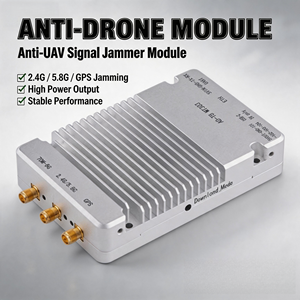
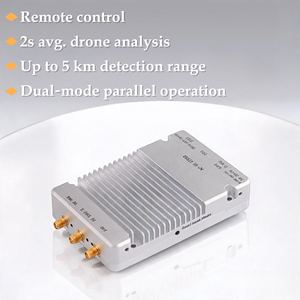
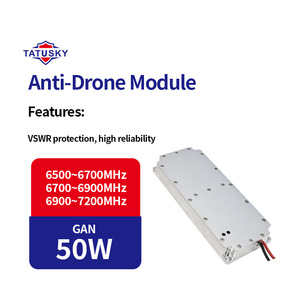
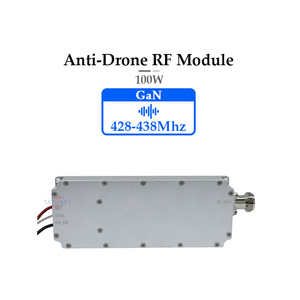
With modern warfare pivoting toward drone saturation attacks, Korean defense integrators lead the world in counter-UAV development. High-power RF jammer modules—such as our 80W and 100W GaN 700-6000MHz amplifiers—demand specialized DC-DC step-up and step-down converters capable of supplying clean, ripple-free current under intense dynamic pulsing. Any power ripple on the DC rail degrades RF spectral purity, diminishing jammer range. Our military converters deliver less than 30mV peak-to-peak output noise, ensuring maximum jamming efficiency against commercial and military drone links (including DJI O4 and sub-GHz FPV controls).
C. Naval Shipboard & Zonal Power Distribution Systems
Naval combatants built by South Korean shipyards require DC-DC converters compliant with MIL-STD-1399 Section 300 shipboard electrical standards. In naval zonal architectures, central AC-DC rectifiers feed high-voltage DC distribution buses. Our isolated DC-DC converters step down these buses to feed localized bridge navigation electronics, weapons guidance controllers, and autonomous surface vessel (ASV) power networks, equipped with N+1 active current sharing for mission-critical redundancy.
3. Technical Parameter Comparison: Industrial vs. Korean Military CE-Certified Converters
To assist procurement directors and chief technology officers in qualifying power hardware, the matrix below details the performance deltas between standard commercial products and our CE-certified military DC-DC power converters.
| Technical Parameter | Standard Industrial Converter | Korean CE Military DC-DC Converter | Defense Advantage |
|---|---|---|---|
| Input Transient Protection | Varistor (Limited to 45V DC) | Active MIL-STD-1275E Clamping (100V/50ms surge, ±250V spike) | Zero downtime during engine starting or load dump |
| EMI / EMC Compliance | EN 55032 Class A | MIL-STD-461G (CE102, RE102) & CE EMC 2014/30/EU | No radio frequency interference with tactical comms |
| Operating Temperature | -20°C to +70°C (Derated) | -40°C to +85°C Baseplate (No derating up to +70°C) | Reliable operation in Arctic and Desert theaters |
| Vibration & Shock | IEC 60068-2-6 (Standard) | MIL-STD-810H Method 514.8 & MIL-S-901D Grade A Shock | Survives direct artillery shock & rough terrain impact |
| Dielectric Isolation | 1,500V DC Isolation | 3,000V DC Primary-to-Secondary / 2,000V DC Chassis | Prevents ground loops and protects delicate digital processors |
| MTBF (Reliability) | > 250,000 Hours (Telcordia) | > 1,200,000 Hours (MIL-HDBK-217F @ Ground Benign 25°C) | Extended 15+ year operational service lifecycle |
4. Regional Trends & Globalization of South Korea's Defense Supply Chain
The defense electronics market in South Korea is undergoing a seismic shift driven by three primary industrial trends:
- Localization of Core Defense Components (K-Defense Initiative): South Korea's Defense Acquisition Program Administration (DAPA) is actively prioritizing domestically produced, CE-marked power conversion hardware to reduce dependency on foreign ITAR-restricted components, ensuring complete control over export licenses.
- Interoperability with NATO & European Defense Standards: As Polish, Eastern European, and Middle Eastern defense ministries finalize multi-billion dollar procurements of Korean military platforms, power supply manufacturers in Korea must certify all subsystem electronics to European Union CE standards alongside US MIL-STDs.
- Thermal Density Optimization via GaN Semiconductors: The miniaturization of missile electronics, soldier-portable counter-drone systems, and unmanned ground vehicles (UGVs) demands higher switching frequencies (500kHz to 2MHz). By switching to GaN FETs, our DC-DC power converters achieve power densities exceeding 50 Watts per cubic inch.
5. Enterprise Strengths & Quality Assurance Credentials
Backing our position as leading CE certified military DC to DC power converter manufacturers and exporters in Korea is decades of dedicated power engineering experience. Operating under CAGE Code 0P327 and a fully certified ISO 9001 Quality Management System accredited through Perry Johnson Registrars (PJR) and ANAB, our engineering facility combines state-of-the-art automated manufacturing with defense-grade testing capability.
Full-Spectrum Customization (COTS / MOTS)
We specialize in rapid Modified Commercial-Off-The-Shelf (MOTS) engineering. By leveraging pre-qualified modular topologies, we can modify output rails, connector types (MIL-DTL-38999 circular connectors), enclosure footprints, and conformal coatings in weeks rather than years—dramatically lowering NRE costs.
In-House Qualification & Testing Matrix
Every power converter lot undergoes rigorous burn-in screening under full dynamic load, environmental thermal cycling, dynamic EMI spectrum scanning, and high-potential dielectric breakdown testing before export dispatch, accompanied by complete Certificate of Conformance (CoC) documentation.