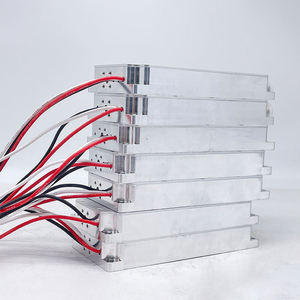
High-efficiency, ruggedized AC-DC, DC-DC, and solid-state RF power amplification modules engineered for mission-critical deployments across Japan and international allied defense sectors.

Japan’s advanced industrial manufacturing ecosystem—spanning robotics in Aichi, semiconductor equipment in Tokyo and Kyushu, aerospace research in Tsukuba, and naval electronics defense in Yokosuka—demands power supply solutions that combine extreme power density, electromagnetic immunity, and unmatched thermal resilience. As Japanese Original Equipment Manufacturers (OEMs) shift toward next-generation power electronics, traditional Silicon (Si) MOSFET switched-mode power supplies (SMPS) are increasingly yielding to Gallium Nitride (GaN) and Silicon Carbide (SiC) wide-bandgap topologies.
Selecting the right switching power manufacturer and supplier in Japan requires evaluating deep technical metrics: total harmonic distortion (THD), Zero Voltage Switching (ZVS) resonant capabilities, line/load transient response under harsh dynamic conditions, and strict compliance with Japanese Industrial Standards (JIS) and international military specifications. Modern applications no longer view power supplies as passive components; they are critical, software-configurable sub-systems that dictate overall system uptime, thermal dissipation budgets, and electro-magnetic compatibility (EMC).
By transitioning from conventional silicon switches to high-electron-mobility GaN transistors, modern switching power units achieve switching frequencies exceeding 1 MHz. This drastically reduces the volumetric size of passive magnetics (transformers and inductors) by up to 65%, allowing Japanese automation systems to integrate ultra-compact power units directly into robotic joints, drone payloads, and sealed IP67 defense electronics chassis.
Precision power conversion is tailored to meet specific environmental, electrical, and structural demands unique to Japan's technological infrastructure:
Factory automation lines in Nagoya and Osaka rely on low-ripple DC-DC converters and rack-mount AC-DC supplies capable of operating continuously under 24/7 dynamic pulse loads. High noise immunity prevents interference with sensitive servo feedback loops and programmable logic controllers (PLCs).
For shipboard power systems deployed across naval bases in Sasebo and Maizuru, power supplies must withstand MIL-STD-1399 (Section 300) power quality limits, MIL-S-901 high-impact mechanical shock, and severe salt-fog corrosion via specialized conformal coatings and fully sealed IP67 enclosures.
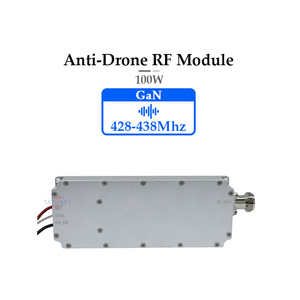
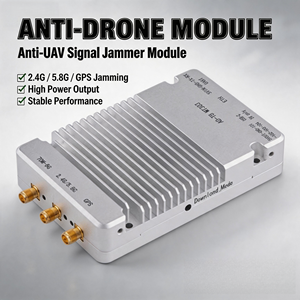
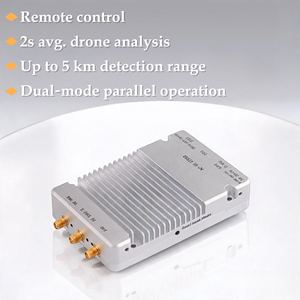
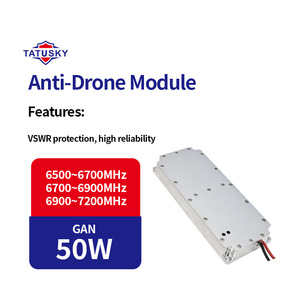
Defense integrators developing anti-drone and FPV defense systems require high-power broadband RF power amplifier modules (433MHz, 1.2GHz, 5.8GHz, 7.0GHz bands) with integrated power switching circuits, delivering pulse output powers up to 100W while maintaining thermal equilibrium.
To assist procurement engineers and systems integrators in evaluating hardware solutions, the table below provides a comparative analysis of baseline switching topologies against high-reliability GaN-based power architectures.
| Performance Parameter | Standard Commercial SMPS | Industrial Grade (JIS Compliant) | Defense-Grade GaN / MIL-STD (AJPS Spec) |
|---|---|---|---|
| Switching Frequency | 50 kHz – 150 kHz | 100 kHz – 300 kHz | 500 kHz – 2.5 MHz |
| Peak Power Efficiency | 85% – 89% | 90% – 94% | 96.5% – 99.4% |
| Operating Temp Range | -10°C to +50°C | -20°C to +70°C | -40°C to +85°C (Extended Thermal Shock) |
| Transient Spike Clamping | Basic MOV Protection | Enhanced TVS Suppression | MIL-STD-1275 / MIL-STD-704 Compliant |
| Ingress Rating | IP20 (Open Frame / Vent) | IP54 / IP65 Conduction Cooled | IP67 / IP68 Fully Potted & Hermetic |
| EMC / EMI Compliance | VCCI Class A / EN55032 | VCCI Class B / CISPR 32 | MIL-STD-461G (CE102, RE102) |
Three dominant macro trends are currently reshaping the procurement criteria for switching power supplies among Japanese enterprises:
Under Japan’s national Green Transformation roadmap, power supplies used in datacenters, industrial machinery, and telecom infrastructure must minimize idle power loss and achieve Titanium-level (80 PLUS) efficiency standards. Switching power suppliers must implement power factor correction (PFC) stages achieving >0.99 power factor under full load, mitigating harmonic distortion on local electrical grids.
As equipment footprints shrink in cleanroom environments across Prefectures like Kumamoto and Kanagawa, high-power switching modules are moving away from traditional wire-wound transformers toward planar magnetics integrated into multi-layer PCB structures. Coupled with Direct-Bonded Copper ceramic substrates, heat is rapidly drawn away from active GaN switches directly into cold plates or liquid cooling loops.
With Japan’s updated defense posture emphasizing unmanned system resilience, demand has surged for modular 10W–100W GaN Solid-State Power Amplifiers (SSPAs) operating across 400MHz to 7.2GHz. These modules incorporate localized DC-DC buck/boost power stages to maintain high linearity and efficiency even when running on fluctuating battery DC buses.
Key technical and regulatory considerations for Japanese engineering teams and procurement specialists acquiring switched-mode power supplies and defense power modules: